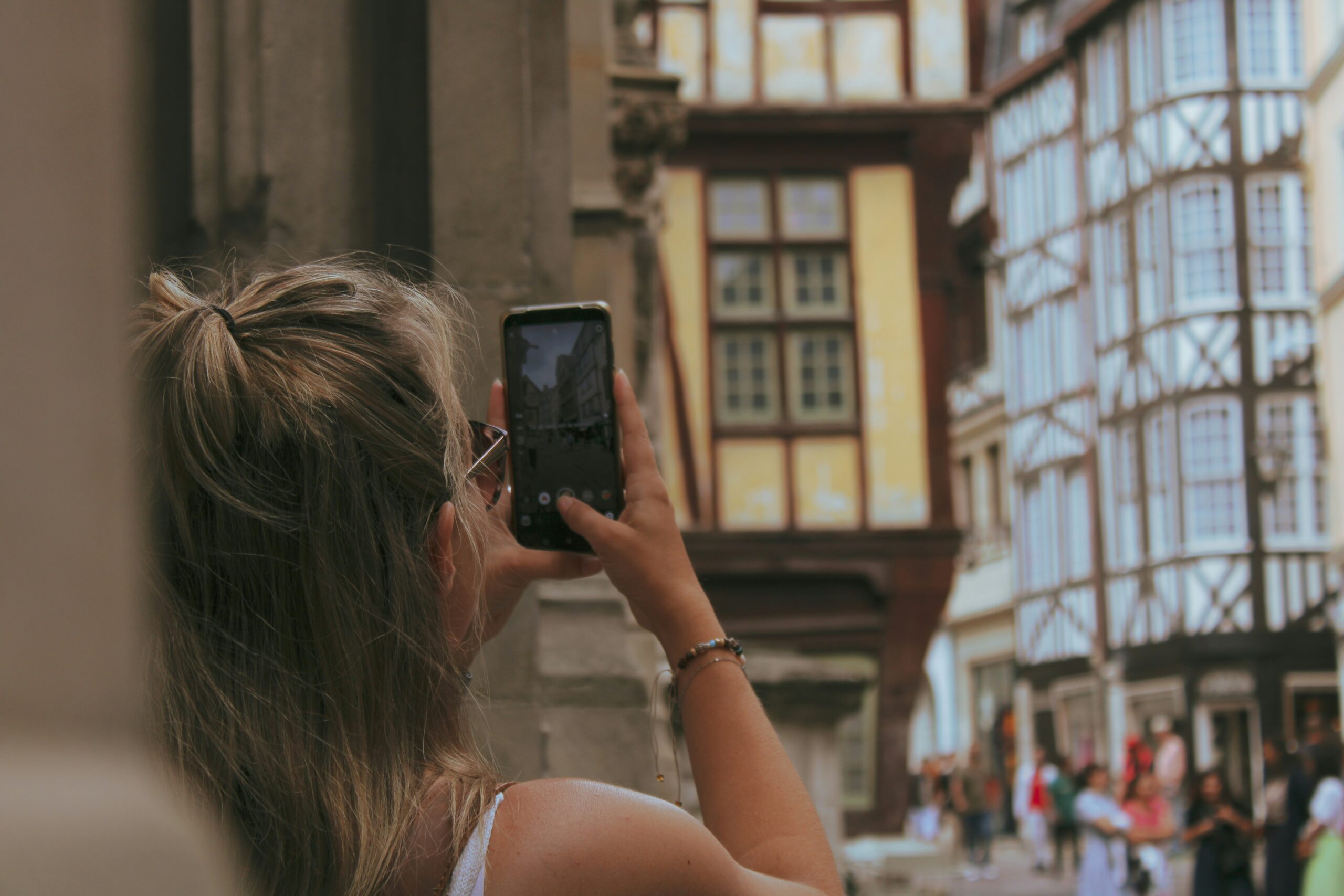
The most beautiful streets of Rouen
Nine streets, lanes, and alleyways you shouldn’t miss for photos ranked in the order I recommend discovering them, from the Big Clock to spots few visitors find on their own.
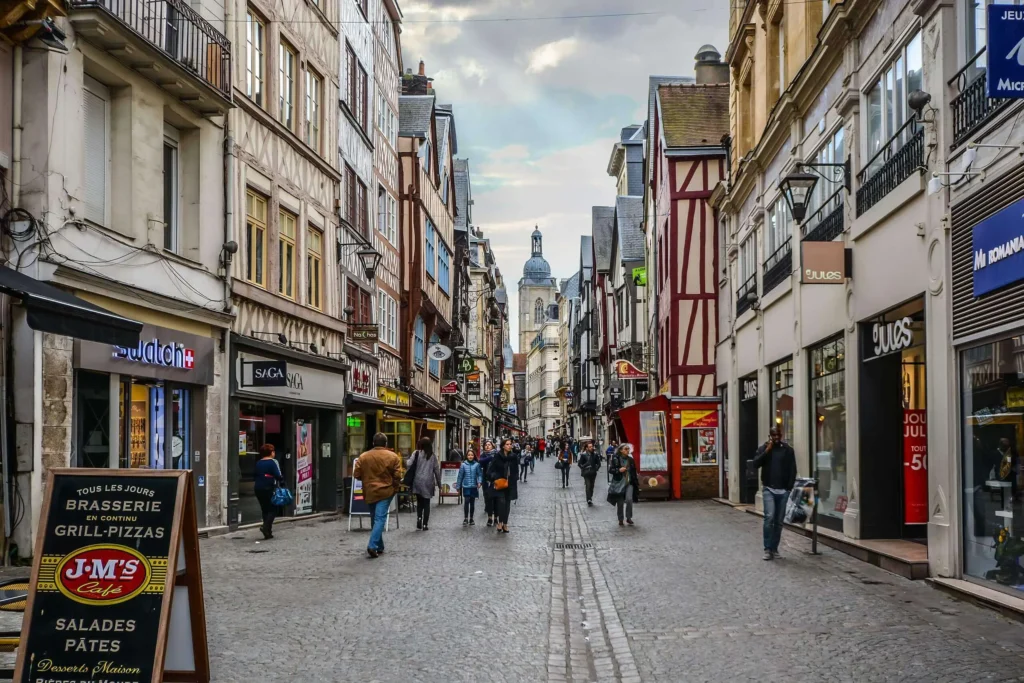
Big Clock street
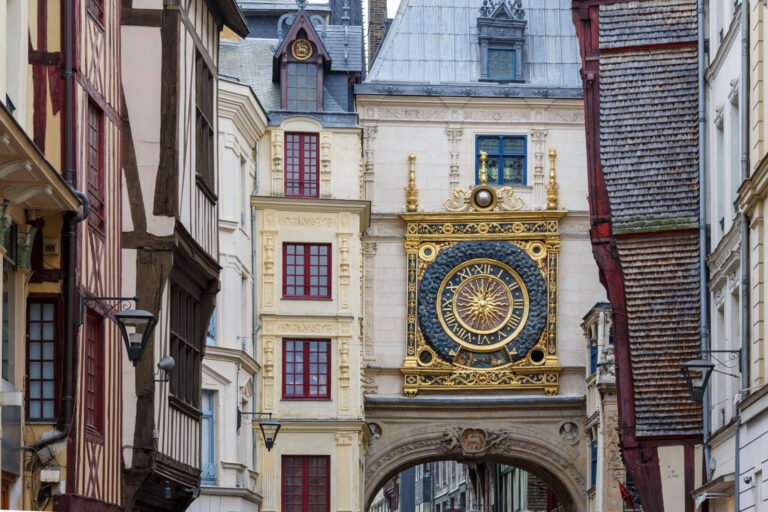
Rouen’s most photographed street, and for good reason: its golden Renaissance archway spans the pedestrian street, with the cathedral as a backdrop on one side and the old Market place on the other. Half-timbered facades line the entire length, some more than 500 years old.
Photo tip: come before 9am. After that, the street fills up and the archway disappears into the crowd.
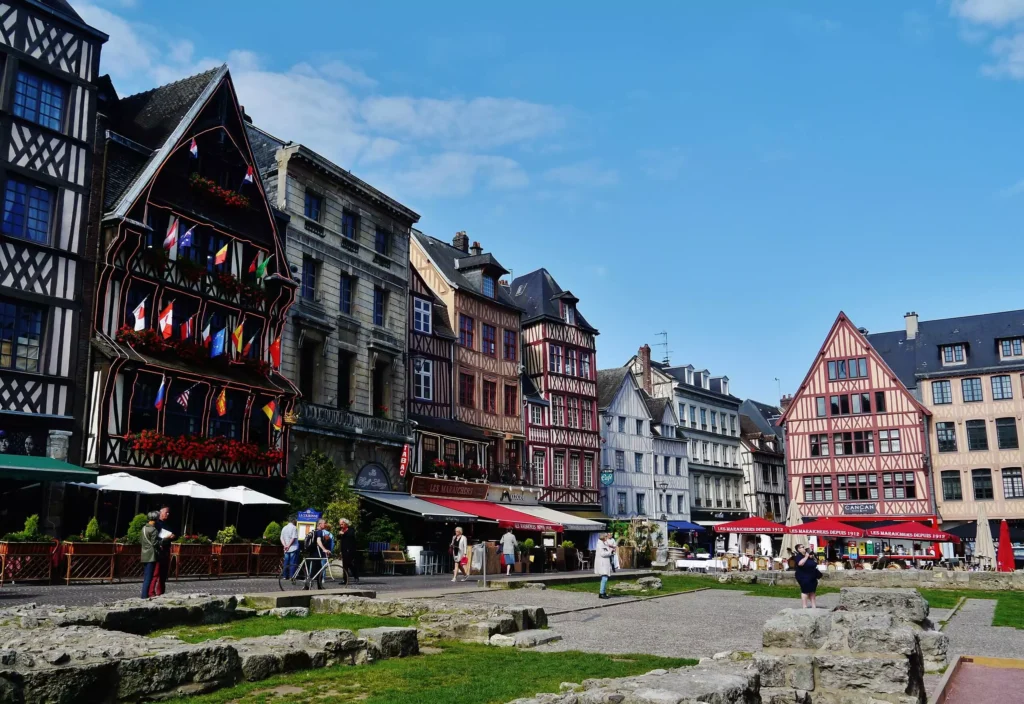
The old market place
This is where Joan of Arc was burned at the stake in 1431, a tall cross marks the spot. All around, covered market halls, lively terraces, and the Sainte-Jeanne-d’Arc church, whose wavy roofline evokes the flames of the pyre. The food market, held Tuesday through Sunday mornings, adds even more color to your shots.
Good to know: the square transforms completely in the evening, once the terraces light up — two very different atmospheres in one visit.
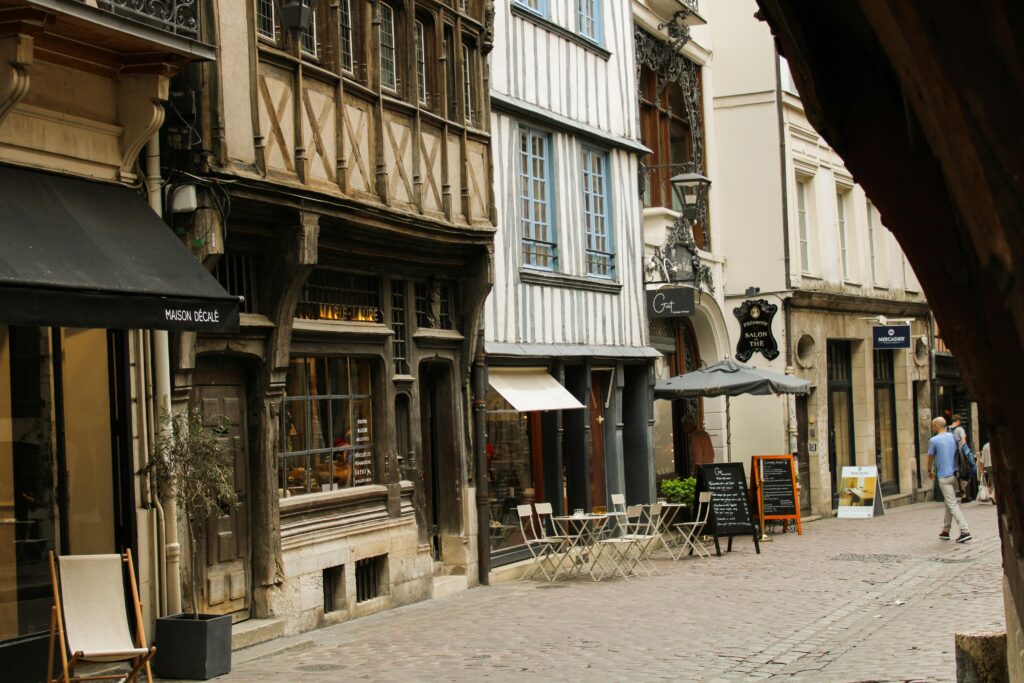
Saint-Romain street
One of the best-preserved medieval streets in France. On one side, the flank of the cathedral with its gargoyles; on the other, an unbroken row of 15th-century half-timbered houses, some leaning at dramatic angles. Morning light slides down the street and sculpts every timber beam.
Photo tip: Stand at the Aître Saint-Maclou (located behind the Church of Saint-Maclou, which itself faces Rue Saint-Romain) and look toward the cathedral. This is an angle that few visitors think to try.
Martainville street and Saint-Maclou cemetery
A magnificent street lined with a colorful row of half-timbered houses, and in the middle of this street stands the Saint-Maclou cemetery, a former mass grave accessible via an alley so narrow that it deserves a mention here. It is one of the last half-timbered ossuaries in Europe, adorned with carvings of skulls, crossed bones, and hourglasses. Surprising, peaceful, and almost always deserted.
Good to know: entry is free, through an easy-to-miss door at Martainville street, 186 many visitors walk right past it.
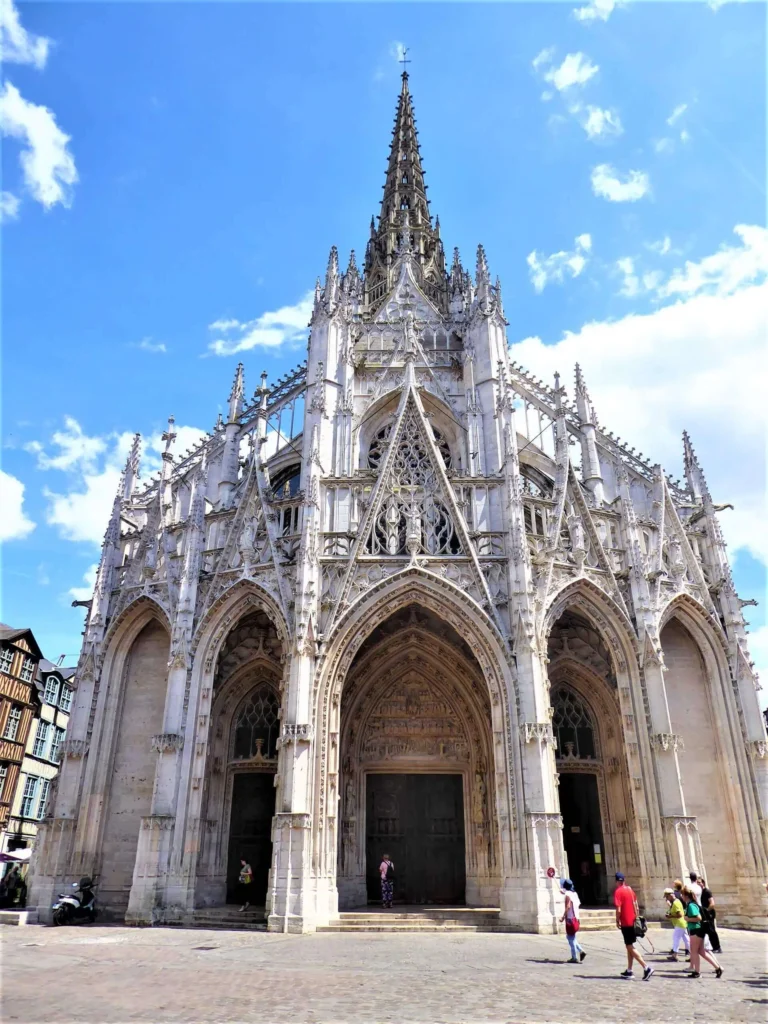
Eau-de-Robec street
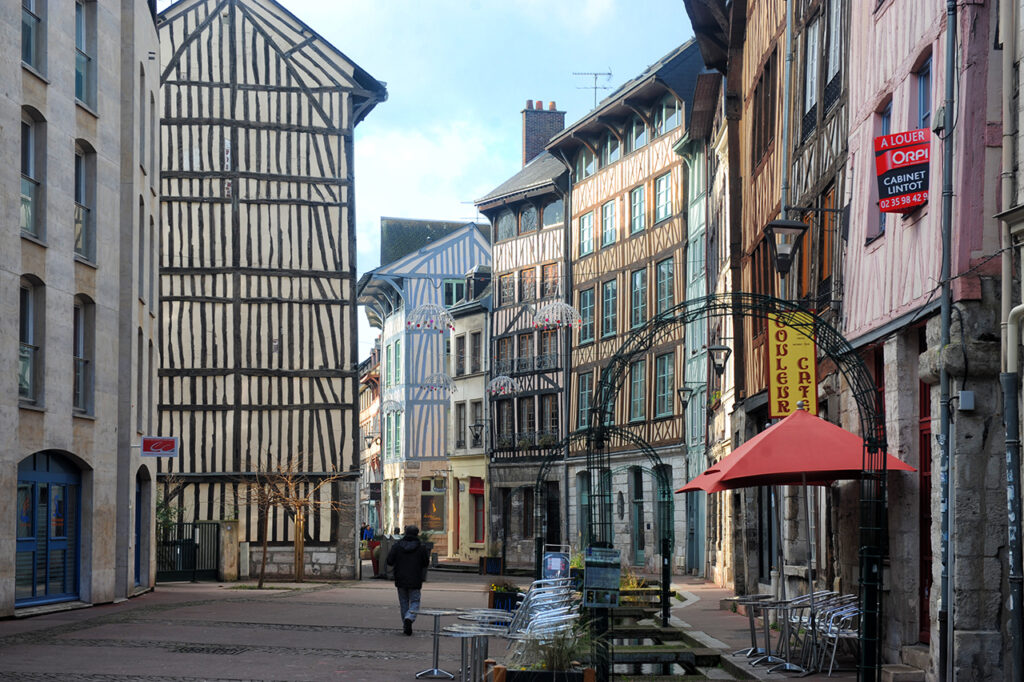
One of the most beautiful streets in Rouen is Rue Eau-de-Robec. A small canal runs down the middle of the street, lined with brightly colored half-timbered houses: yellow, blue, and pink. It was once the dyers’ quarter, where they used water from the Robec River. Today, it’s one of the most widely shared images of Rouen, yet it remains quiet.
Photo tip: reflections in the canal are sharpest in late afternoon, when the sun sits lower in the sky.
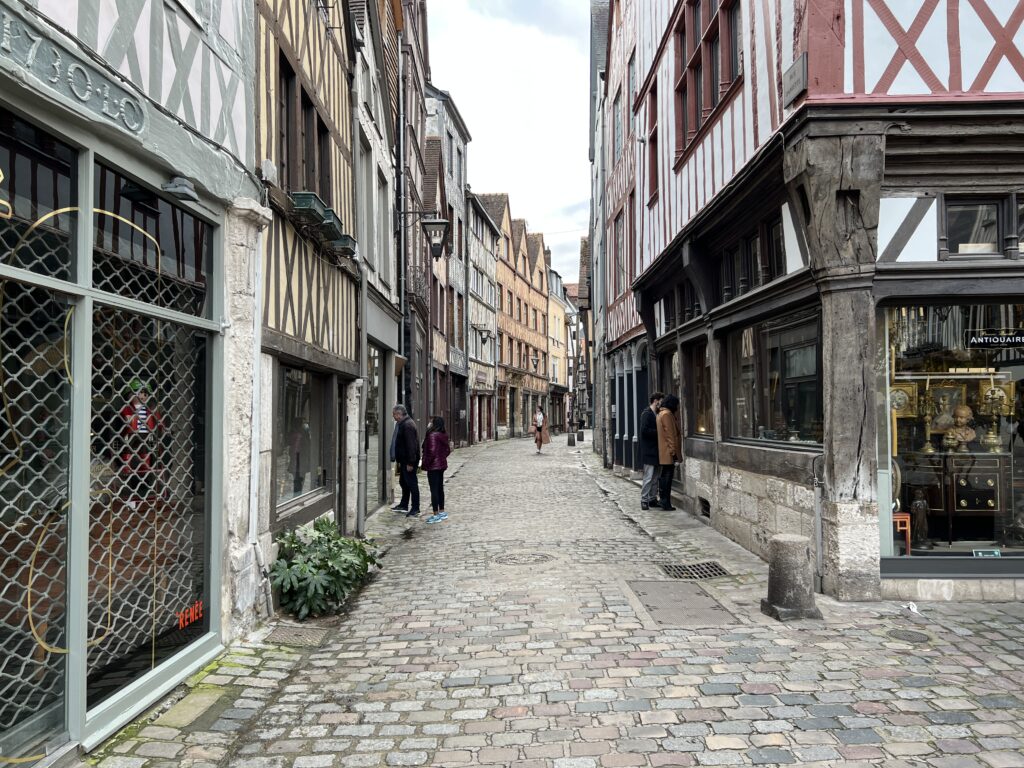
Damiette street
An extension of Rue Eau-de-Robec, this pedestrian street is home to independent boutiques, craft workshops, and art galleries set inside half-timbered houses. The mood is calmer and more “village” than the touristy core. Perfect for wandering without a fixed plan.
Good to know: many shops close on Mondays. Plan a midweek visit if you want to step inside the workshops.
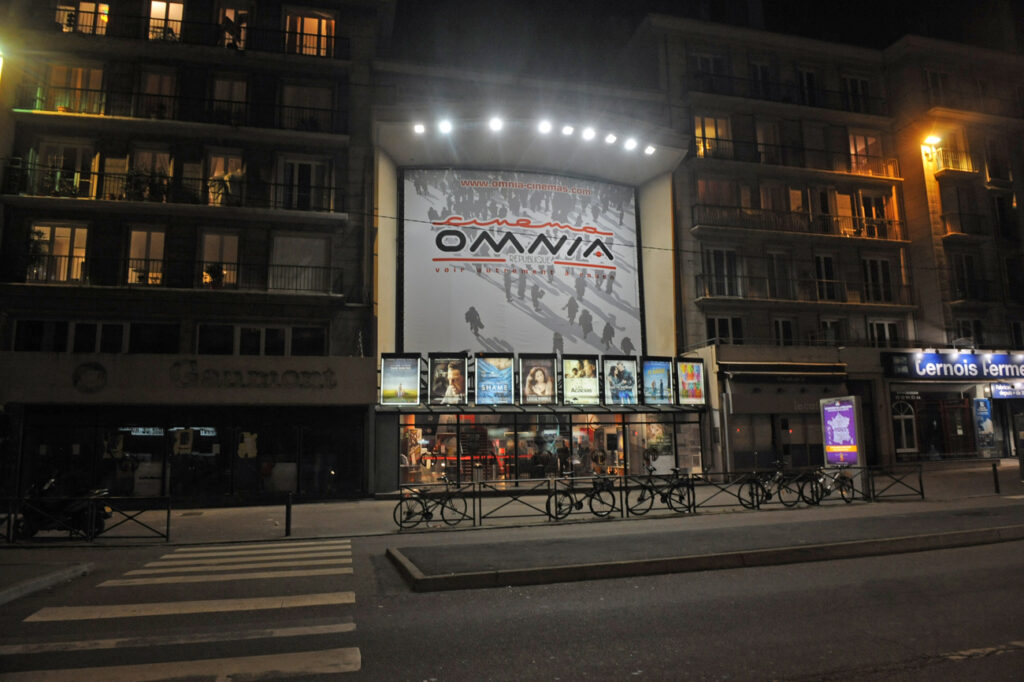
République street (view from the quay)
This major street links the Seine to the historic center. Walking up from the riverbanks toward downtown, the cathedral’s spire, the tallest in France, gradually rises above the rooftops. It’s one of the few spots where you can take in Rouen’s skyline as a whole.
Petit-Salut street and its neighboring lanes
A maze of small streets behind the cathedral, where a handful of craft workshops, stained-glass restoration studios, and galleries remain. The contrast between the cathedral’s massive stonework and the tiny scale of these lanes makes for striking, almost surreal photos.
Good to know: this is also where some of the cathedral’s old maintenance workshops are tucked away.
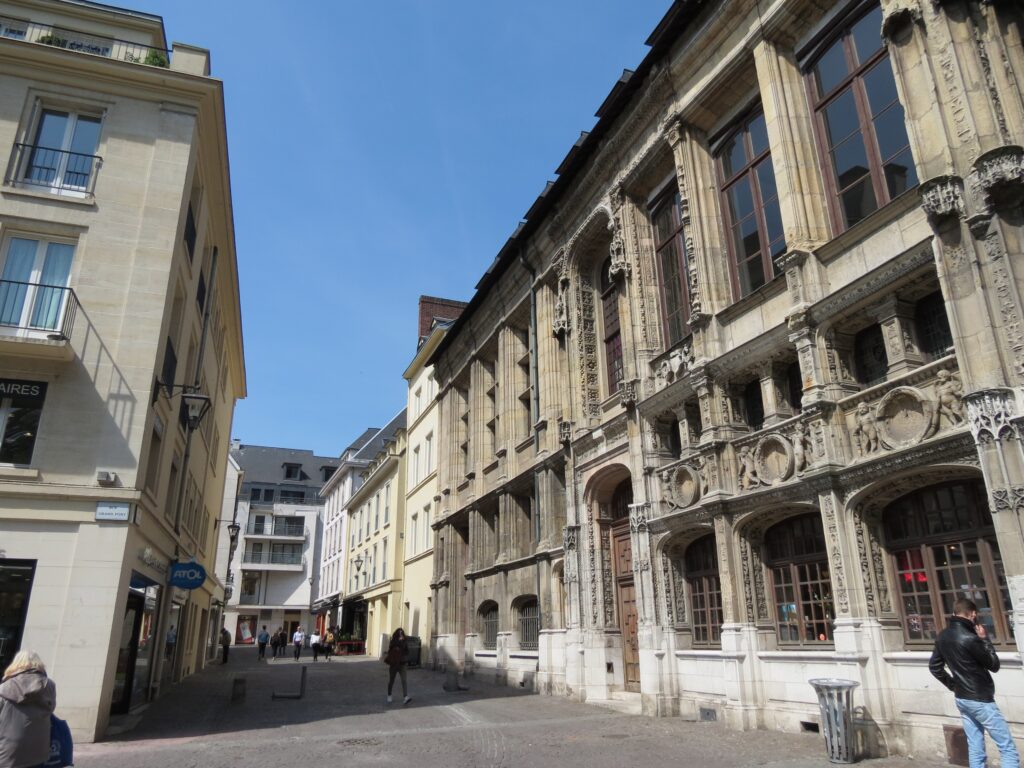
Albane’s Gardens
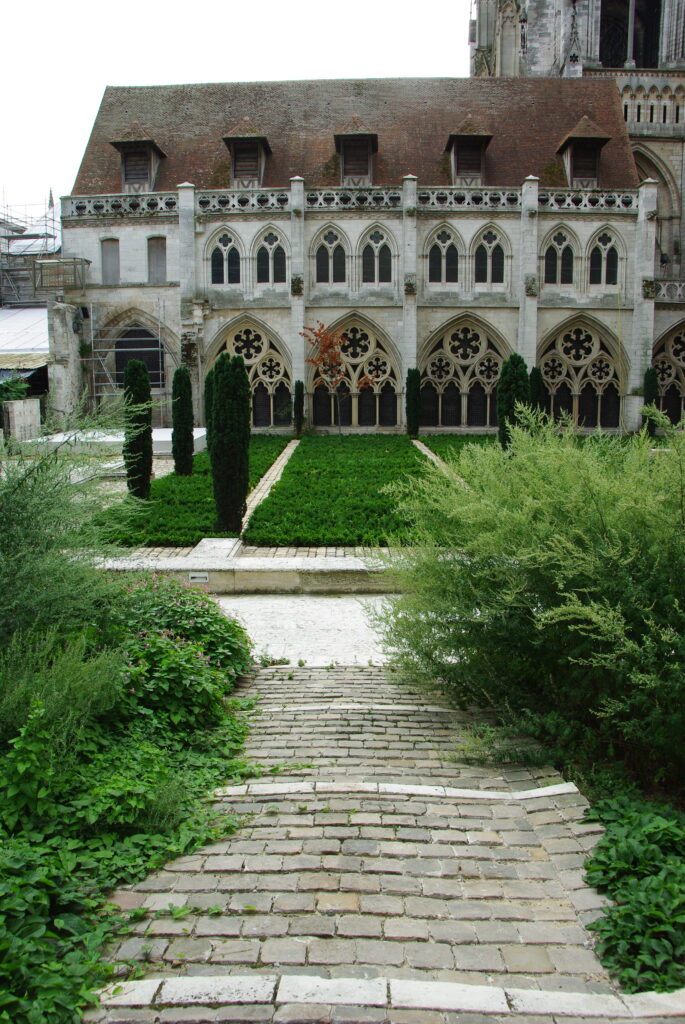
Just steps from the cathedral, this quiet garden occupies the former canons’ cloister, tucked behind the walls of the Archbishop’s Palace. Manicured lawns, century-old trees, and a view of the cathedral’s east end create a silent pocket far removed from the bustle of the Gros-Horloge. Most visitors don’t even know it exists.
Good to know: access is through a discreet gate near the cathedral and depends on opening hours. Exactly the kind of spot a local guide knows when and how to bring you to.
Saint-Romain street and Eau-de-Robec street are usually the top picks, but they offer different kinds of photos: the first for its unbroken medieval row, the second for its color and canal. Ideally, visit both, they’re only a ten-minute walk apart.
Plan for about 2.5 to 3 hours at a relaxed pace, with stops for photos and a lunch break on Rue Martainville. It’s a compact route, easily done in half a day.
Early morning (before 9am) for busy pedestrian streets like the Big Clock, and late afternoon for Eau-de-Robec street and cathedral views, when the light turns golden.
Yes, all of these streets are outdoors and accessible all year. The Aître Saint-Maclou and the Jardins de l’Albane have opening hours that can vary.